25 Best Public Art Installations in New York City
As you explore New York City’s vibrant streets, you’ll encounter public art that boldly critiques societal norms, from the empowering Fearless Girl confronting consumerism to the thought-provoking High Line sculptures. Yet, beneath their aesthetic appeal lies deeper questions about cultural identity—ones that might reshape your perspective on urban life.
The Fearless Girl
The Fearless Girl statue boldly confronts Wall Street’s Charging Bull, symbolizing women’s empowerment in a male-dominated financial world.
You analyze the fearless girl symbolism, critiquing how it challenges corporate patriarchy yet risks commodification.
It prompts you to reflect on the fearless girl impact, sparking global conversations on gender equity while questioning if it’s mere PR for its sponsors.
Charging Bull
Standing defiant in New York’s financial district, Charging Bull embodies raw capitalist aggression, its muscular form charging forward as a symbol of market dominance that you’ve likely encountered in debates over economic inequality.
- You’ll view bull symbolism as raw power driving the financial district’s relentless energy.
- It challenges you to critique capitalism’s aggressive inequalities head-on.
- The bull’s form actively questions market volatility you’ll navigate daily.
- In the financial district, it insightfully highlights enduring economic disparities you can’t overlook.
The Vessel at Hudson Yards
Dominating Hudson Yards with its honeycomb-like ascent, the Vessel challenges you to navigate its winding stairs, symbolizing a quest for connection in an increasingly isolated urban landscape.
Even as its steep entry fees and safety concerns expose the commercialization of public art, in Vessel architecture, you’re confronting Hudson Yards’ history of redevelopment.
Yet its exclusivity leaves you questioning whether it fosters inclusive public engagement or merely perpetuates inequality.
Love Sculpture by Robert Indiana
Robert Indiana’s Love Sculpture greets you in Manhattan’s Midtown, its tilted red letters embodying a simple yet profound message of affection that contrasts sharply with the city’s relentless pace.
Though its widespread commercialization risks diluting its original critique of consumerism in modern art.
- You witness Indiana’s Influence as the Love Symbol challenges consumerism’s grip on public art.
- It prompts you to critique how the Love Symbol has become a commodified icon.
- You’re drawn to analyze its bold design, revealing deeper societal reflections.
- Indiana’s Influence invites you to question the Love Symbol’s evolving cultural impact.
Alice in Wonderland Statue
In Central Park’s heart, you encounter the Alice in Wonderland Statue, a bronze ensemble by José de Creeft that whimsically captures Lewis Carroll’s narrative.
Yet it invites you to question how its interactive design, meant to spark childlike imagination, often devolves into a superficial backdrop for tourism, diluting the story’s deeper critique of societal norms.
Here, Alice’s adventures amplify the whimsical design’s insightful critique.
Bethesda Terrace Fountain
As you approach the Bethesda Terrace Fountain, its ornate architecture and flowing waters evoke a sense of tranquility that honors the Angel of the Waters statue’s theme of healing.
Yet you might question how this 19th-century masterpiece, designed by Emma Stebbins, now serves more as a backdrop for fleeting selfies than a profound public reflection on urban renewal.
- You’ll analyze Bethesda Terrace’s Fountain Design for its symbolic depth, revealing urban art’s evolving role.
- Critique how it fosters healing in a bustling city, yet invites superficial engagement.
- Question the Fountain Design’s adaptation to modern crowds, diminishing its historical critique.
- Reflect on Bethesda Terrace’s balance of beauty and accessibility, challenging public art’s purpose.
Strawberry Fields Memorial
Strawberry Fields Memorial, a mosaic tribute to John Lennon in Central Park, invites visitors to reflect on peace and imagination, yet its quiet symbolism often clashes with the throngs that treat it as a mere photo op, diluting the original intent of fostering genuine contemplation in an urban setting.
Yet, the strawberry fields tribute’s john lennon memorial urges you to engage critically, revealing how commercialization undermines its profound, introspective purpose.
Cleopatra’s Needle
Cleopatra’s Needle, the ancient Egyptian obelisk that now graces Central Park, forces you to confront its stark relocation from the Nile’s banks to a modern urban expanse, where erosion and tourist crowds erode its original mystique.
This reveals how such relics often serve as mere exotic backdrops rather than catalysts for deeper historical inquiry.
- You’ll analyze the ancient artifact’s historical significance, tracing its 3,500-year legacy amid New York’s chaos.
- You’re compelled to critique how urban life diminishes its ancient mystique, fostering shallow admiration.
- It pushes you to question if this historical significance inspires genuine reflection or just photo ops.
- You’ll ponder how erosion strips away layers, urging critical engagement with its Egyptian roots.
Imagine Mosaic
Shifting from ancient relics to modern tributes, the Imagine Mosaic in Central Park immerses you in John Lennon’s vision of peace.
Yet it often transforms into a superficial draw for tourists, stripping its profound message of genuine introspection amid the city’s relentless buzz.
As you examine the mosaic techniques, they encourage community engagement, but you might find this approach rather shallowly executed.
The Unisphere
The Unisphere, that towering stainless steel globe in Flushing Meadows-Corona Park, captures the 1964 World’s Fair’s vision of global unity, yet its polished facade masks the era’s social fractures.
- You’ll discover unisphere history, tracing its construction in the early 1960s as a World’s Fair centerpiece symbolizing peace.
- In unisphere design, you’ll admire the innovative 140-foot stainless steel orb with detailed continents and orbiting rings.
- Critically, it exposes how unisphere history glosses over racial tensions, critiquing false unity narratives.
- You’ll relate it to modern divides, questioning if unisphere design still promotes superficial harmony.
Queensbridge Houses Murals
Queensbridge Houses’ murals boldly confront socioeconomic struggles through their vivid depictions of community resilience, urging you to question how public art in this Queens housing complex amplifies voices often sidelined in New York’s narrative.
Bushwick Collective Street Art
Bushwick Collective’s street art pulses through Brooklyn’s streets, challenging societal norms with its raw, evolving murals that you’ve likely encountered as symbols of urban rebellion.
As you explore, bushwick murals deliver powerful urban expression, critiquing society while inspiring change.
- They provoke you to question inequality, highlighting raw emotions in vibrant strokes.
- Bushwick murals immerse you in community voices, blending critique with relatable stories.
- Their evolution keeps urban expression fresh, yet risks commercialization’s dilution.
- You must weigh their accessibility against fading authenticity in a gentrifying landscape.
5Pointz Graffiti Site
Pointz Graffiti Site emerges as Queens’ defiant canvas, where aerosol art once clashed with urban development, forcing you to confront the tension between creative freedom and corporate erasure.
Delving into pointz history, you’ll uncover a vibrant hub of street expression that sparked intense legal battles, critiquing how authorities prioritized profit over preserving this raw, innovative cultural battleground that empowered artists against systemic erasure.
Whitney Museum Outdoor Installations
The Whitney Museum’s outdoor installations thrust you into a dynamic dialogue between art and urban life, where pieces like David Hammons’ sculptures challenge societal norms with unyielding critique.
- You’ll critically analyze how Whitney Museum’s outdoor exhibits expose social inequalities, forcing reflection on everyday realities.
- As you engage with these pieces, they actively disrupt your views on urban culture and privilege.
- It’s insightful to critique how outdoor exhibits blend art with the city’s rhythm, enhancing immersive experiences.
- Critically, not all Whitney Museum outdoor exhibits fully sustain your interest or provoke lasting change.
New York Earth Room
Nestled in a SoHo loft, the New York Earth Room’s 250 cubic yards of soil compel you to question art’s essence, transforming ordinary earth into a stark critique of consumerism and environmental neglect.
As you engage with the earth room experience, its artistic interpretation forces you to critically assess humanity’s environmental impact, offering profound insights into ecological crises and societal flaws.
Broken Kilometer
Broken Kilometer, another Walter De Maria masterpiece in SoHo, immerses you in a grid of 500 gleaming brass rods that total a kilometer, forcing you to confront the illusion of space and the rigidity of human constructs.
Where each segment’s precision critiques modern life’s fragmented pursuit of order and infinity.
- Broken kilometer significance: You’ll question infinity’s elusive grasp, revealing life’s illusions.
- Broken kilometer location: In SoHo’s Dia Art Foundation, it demands your critical engagement.
- Analytical insight: It exposes how precision masks fragmentation in daily routines.
- Critical reflection: You’re compelled to rethink human constructs’ rigid flaws.
The Gates by Christo and Jeanne-Claude
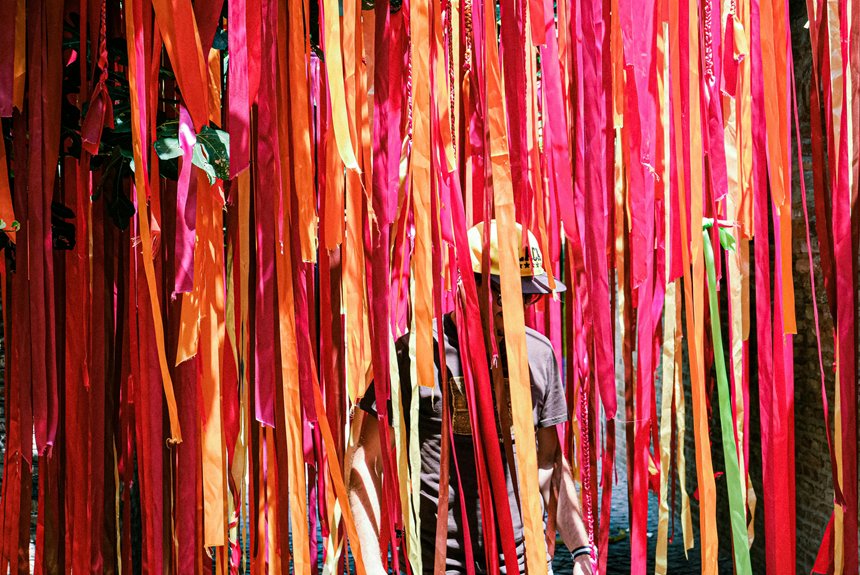
As you stroll through Central Park, Christo and Jeanne-Claude’s The Gates transform the landscape with 7,500 saffron-fabric panels fluttering along winding paths, inviting you to question how temporary art disrupts urban routines and exposes the fleeting nature of public spaces.
Yet, you recognize the Gates’ significance in engaging the public, while grappling with installation challenges such as permitting issues and weather vulnerabilities.
Times Square Kinetic Sculptures
Venture into Times Square, and you’ll find its kinetic sculptures whirling with mechanical grace, transforming the chaotic backdrop of neon lights and tourist throngs into a provocative commentary on urban dynamism.
- As you witness the kinetic movement, it pulls you into a whirl of motion that demands attention.
- You’ll engage in the interactive experience, allowing hands-on participation that sparks personal reflection.
- Critics decry how it commercializes art, merging kinetic movement with ads in a superficial display.
- Yet, it insightfully reveals urban tensions, critiquing the interactive experience’s fleeting nature.
Brooklyn Bridge Public Art
Brooklyn Bridge’s public art installations draw you into a historical narrative that contrasts sharply with Times Square’s mechanical frenzy.
As you explore, you’ll engage with Brooklyn Bridge history, where sculptures vividly echo its 1883 origins and engineering triumphs.
Critically, though, they sometimes oversimplify Brooklyn Bridge architecture, romanticizing the Gothic arches without fully capturing the laborers’ grueling feats, urging deeper scrutiny.
Coney Island Parachute Jump
Coney Island’s Parachute Jump looms as a faded icon of thrill-seeking innovation, its 250-foot structure once dropping riders into adrenaline-fueled free falls that captured the era’s bold spirit.
You’ll find its Parachute Jump significance tied to Coney Island history in these ways:
- It marks the amusement park’s golden age, blending entertainment with early public art.
- Symbolizes technological feats that critiqued societal progress in the 1940s.
- Highlights preservation failures, offering a critical lens on cultural neglect.
- Invites you to reflect on how thrill evolves, making history personally relatable.
Harlem Renaissance Murals
Harlem’s Renaissance murals vividly depict the cultural rebirth of the 1920s, drawing you into powerful scenes that celebrate African American identity while critiquing systemic racism.
As you explore these Harlem murals, the Renaissance influence prompts critical reflection on racial dynamics, urging you to recognize their enduring role in fostering social change and cultural pride.
It also challenges you to address ongoing disparities.
SoHo Cast Iron District Art
In SoHo’s Cast Iron District, public art installations repurpose historic iron facades into thought-provoking statements, challenging you to examine how commercialization erodes cultural authenticity.
As you engage with SoHo architecture and Cast iron history, you’ll gain critical perspectives on urban art.
- You’ll discover how SoHo’s iron structures inspire modern critiques of commercialization.
- It’s fascinating to see history interwoven with contemporary issues in these pieces.
- Critically assess the impact of commercialization on authenticity through these installations.
- Reflect on art’s role in preserving Cast iron history amid urban evolution.
Governor’s Island Contemporary Pieces
Governor’s Island features contemporary art pieces that boldly reinterpret its historic landscape, urging you to question how these installations confront environmental change and colonial legacies.
In the outdoor exhibitions of Governor’s Island art, you’ll critically assess their innovative forms, appreciating how they spark insightful dialogues on society.
Yet some pieces fall short in depth, demanding you seek fuller narratives.
Roosevelt Island Four Freedoms Park
Roosevelt Island’s Four Freedoms Park memorializes Franklin D. Roosevelt’s vision of liberty.
As you explore this serene site on Roosevelt Island, you’ll critically analyze its minimalist design, weighing its symbolic depth against modern relevance.
- You’ll appreciate the stark geometry evoking contemplation of the Four Freedoms.
- It insightfully ties history to personal reflection on rights.
- Critically, the layout favors aesthetics over inclusive access.
- You’ll relate its themes to today’s societal challenges.
High Line Park Sculptures
High Line Park’s sculptures reimagine an elevated railway as a dynamic showcase of contemporary art, inviting you to engage with their bold forms and themes.
You’ll explore high line history, where these installations critically drive urban transformation, challenging you to reflect on industrial decay’s revival and its social implications, though some pieces lack deeper contextual depth.
Final Thoughts
As you reflect on New York City’s 25 best public art installations, from the defiant Fearless Girl to the High Line’s immersive sculptures, you’re invited to critique their deeper messages. These works challenge societal norms and celebrate resilience, yet they often gloss over ongoing inequalities. Engage critically—you’re the key to transforming passive viewing into meaningful, thought-provoking action.