25 Best Historical Sites to Visit in New York City
You can explore New York City’s 25 best historical sites, from the Statue of Liberty’s enduring symbol of freedom to Ellis Island’s tales of immigration. These landmarks reveal America’s diverse past, prompting you to contemplate their cultural impact. Now, let’s examine what makes each one essential.
Statue of Liberty
As you approach New York Harbor, you’ll encounter the Statue of Liberty, a colossal neoclassical sculpture that France gifted to the United States in 1886.
You’ll analyze the statue’s significance as a beacon of international friendship and democracy.
Liberty symbolism, through elements like the torch and crown, objectively represents enlightenment and freedom’s pursuit, inviting analytical reflection on its cultural impact.
Ellis Island
Ellis Island, once the primary gateway for immigrants, processed over 12 million arrivals between 1892 and 1954, shaping America’s cultural mosaic.
As you visit this site, you’ll examine its rich immigration history and its profound cultural significance to the US.
To enhance your experience, consider these aspects:
- Exploring the Great Hall where immigrants were processed
- Viewing exhibits on cultural significance
- Learning about family histories
- Attending guided tours
- Reflecting on its role in American diversity
Empire State Building
The Empire State Building, completed in 1931, stands as one of the world’s most iconic skyscrapers at 1,454 feet.
Its Art Deco design features geometric elegance and lavish details that reflect 1930s innovation.
You’ll ascend to the observatory for breathtaking skyline views, allowing you to analytically explore New York’s urban growth and the building’s architectural prominence in the cityscape.
Brooklyn Bridge
Spanning the East River, Brooklyn Bridge connects Manhattan and Brooklyn with its innovative suspension design, completed in 1883.
As you explore Brooklyn Bridge history and its architecture, you’ll analyze key elements that define its legacy.
- It was engineered by John Roebling, overcoming 19th-century challenges.
- The suspension cables support a record-breaking span for its time.
- Neo-Gothic towers showcase intricate stonework and height.
- Steel wires demonstrate advanced material innovation.
- It symbolizes urban connectivity and engineering evolution.
Central Park
Central Park, designed in the 1850s by Frederick Law Olmsted and Calvert Vaux, stands as Manhattan’s premier urban oasis, blending natural landscapes with city life.
As you explore Central Park’s history, you’ll uncover its evolution from a 1857 design competition to a public haven.
The park’s architecture, with its winding paths and rustic bridges, provides an analytical lens on 19th-century landscape innovation that you can actively navigate.
Times Square
Times Square dazzles as New York’s electrifying crossroads, where Broadway’s theaters and neon billboards converge to reflect the city’s commercial evolution since the early 1900s.
As a cultural hub, you’ll analyze its vibrant history through neon lights that symbolize urban progress.
- You’ll observe neon lights illuminating Broadway’s theatrical legacy.
- Experience the cultural hub’s role in early 20th-century advertising.
- Note how it evolved as an entertainment epicenter.
- Witness intersections blending commerce and culture.
- Explore its analytical significance in modern tourism.
Grand Central Terminal
While Times Square pulses with theatrical energy, you’ll encounter Grand Central Terminal as a Beaux-Arts icon that has driven New York’s transportation evolution since 1913.
As you explore, you’ll appreciate its architecture significance through the intricate Beaux-Arts design, which embodies early 20th-century innovation.
Its transportation history shows how it centralized rail services, shaping commuter networks and fostering urban growth.
9/11 Memorial
The 9/11 Memorial serves as a profound tribute to the victims of the 2001 attacks, featuring twin reflecting pools on the World Trade Center site that symbolize loss and resilience.
As you explore the 9/11 memorial, you’ll notice its analytical parallels with the Vietnam memorial in commemorating sacrifice.
Key elements to appreciate include:
- Twin reflecting pools etched with victims’ names
- A serene plaza for quiet reflection
- Integration with the adjacent museum
- Annual events honoring resilience
- Symbolic architecture echoing national grief
Rockefeller Center
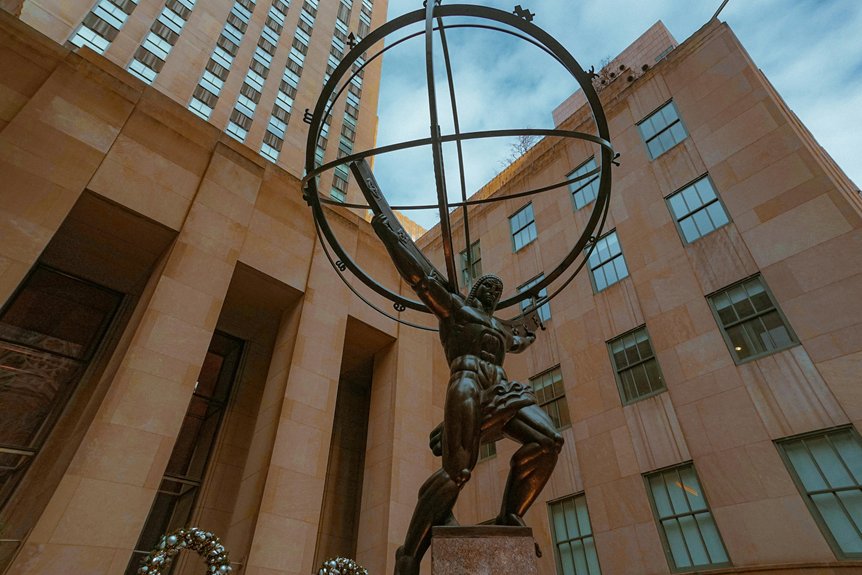
Rockefeller Center emerges as a dynamic complex in Midtown Manhattan, blending Art Deco architecture with cultural landmarks that highlight 1930s innovation.
As you explore, you’ll uncover Rockefeller history, from its ambitious construction during the Great Depression, which exemplifies Art Deco architecture’s elegant design and economic symbolism.
This site offers you an analytical lens on New York’s cultural evolution, fostering a deeper appreciation of its historical impact.
Wall Street
Wall Street embodies the financial powerhouse of Lower Manhattan, where you’ll witness the New York Stock Exchange’s role in driving global markets and economic shifts.
As you explore this historic financial district, analyze these key aspects of the stock exchange:
- Observe the bustling trading floor, symbolizing global commerce.
- Examine architectural icons that reflect economic evolution.
- Study historical markers detailing market innovations.
- Engage with exhibits on financial milestones.
- Assess the district’s influence on modern capitalism.
One World Trade Center
Rising above Lower Manhattan, One World Trade Center dominates the skyline as the tallest building in the Western Hemisphere, embodying resilience after the 9/11 attacks.
Its architectural significance shines through innovative design and symbolic elements.
You’ll experience breathtaking views from the observatory, offering analytical insights into its history and fostering a profound visitor connection to New York’s resilience.
Metropolitan Museum of Art
The Metropolitan Museum of Art, a cornerstone of New York’s cultural scene, houses over two million works spanning ancient civilizations to contemporary art.
You’ll investigate its vast art collections, which underscore the museum’s cultural significance by providing objective analysis of human creativity across eras.
- You’ll examine Egyptian mummies and tombs.
- Analyze Renaissance paintings by masters like Michelangelo.
- Study Asian ceramics and sculptures.
- Explore African tribal art.
- Appreciate contemporary installations that reflect modern cultural issues.
American Museum of Natural History
Shifting from the artistic treasures of the Metropolitan Museum, you’ll discover the American Museum of Natural History, where exhibits vividly showcase Earth’s evolutionary story through fossils, dioramas, and interactive displays that analyze biodiversity and human origins.
As you visit, you’ll explore dinosaur exhibits that analytically reveal the evolution of species, and attend planetarium shows that examine cosmic phenomena and their impact on Earth.
St. Patrick’s Cathedral
You’ll explore St. Patrick’s Cathedral, a prime example of Gothic architecture with profound historical significance.
This landmark showcases:
- Soaring spires that epitomize Gothic architecture’s grandeur.
- Intricate stained glass windows reflecting artistic mastery.
- Vaulted ceilings highlighting structural innovation.
- Its role in key events, underscoring historical significance.
- Preservation efforts that maintain its cultural legacy.
New York Public Library
New York Public Library stands as a neoclassical masterpiece on Fifth Avenue, housing over 50 million items that fuel research and cultural exploration.
As you visit, you’ll analyze its architectural design, from the grand marble facade to the ornate interiors, which optimize access to extensive research resources. This enables you to conduct in-depth studies and uncover historical insights effectively.
Tenement Museum
The Tenement Museum, situated in Manhattan’s Lower East Side, preserves over two dozen restored apartments that vividly recount immigrant stories from the 19th and early 20th centuries.
At the Tenement Museum, you’ll deeply analyze immigrant experiences and cultural heritage through the following elements:
- Touring restored apartments to see daily life firsthand.
- Learning from guides about historical contexts of migration.
- Viewing exhibits on various ethnic heritages and adaptations.
- Participating in interactive programs that analyze immigrant stories in depth.
- Appreciating preserved artifacts highlighting cultural shifts.
Federal Hall
Following the Tenement Museum’s exploration of immigrant narratives, Federal Hall marks the spot where George Washington assumed the presidency in 1789.
You’ll analyze Federal Hall’s history, from hosting the first Congress to the Bill of Rights’ adoption, revealing early democracy’s evolution.
Its architecture, with neoclassical columns and dome, embodies republican ideals, offering you precise insights into the nation’s formative era.
Fraunces Tavern
Fraunces Tavern, dating back to 1762, emerges as a key Revolutionary War site where George Washington bid farewell to his officers in 1783.
You’ll analyze its historical significance in the Revolutionary War through preserved elements that highlight early American struggles.
- Witness the exact room where Washington’s farewell occurred, marking the war’s end.
- Examine artifacts that reveal soldiers’ daily lives and key battles.
- Learn how the tavern served as a strategic meeting spot for revolutionaries.
- Appreciate its role in post-war unity and national identity formation.
- Explore educational displays that objectively detail its broader impacts.
Hamilton Grange
Hamilton Grange, Alexander Hamilton’s cherished estate, invites you to examine his transformative influence on early American finance and politics.
As you tour the site, you’ll explore Hamilton’s Legacy through the Grange Architecture’s Federal-style design, which embodies his innovative ideas and role in shaping the nation’s financial system.
This analytical approach highlights his enduring contributions objectively.
Dyckman Farmhouse
As you explore the Dyckman Farmhouse, you’ll encounter a well-preserved 18th-century structure that reflects Manhattan’s early Dutch colonial era.
This site offers a glimpse into Dyckman Farmhouse history and its distinctive architecture, emphasizing key elements as follows:
- The farmhouse was built in 1785 by the Dyckman family, marking early settlement.
- Its architecture features a gambrel roof and symmetrical facade, typical of Dutch colonial style.
- Inside, restored rooms showcase period artifacts.
- The grounds include original outbuildings, reflecting farm life.
- It provides analytical insights into colonial daily life.
Trinity Church
Trinity Church emerges as a pivotal landmark in Lower Manhattan, founded in 1697 as an Episcopal parish.
As you explore Trinity Church history, you’ll uncover its enduring role in colonial events and key figures like Alexander Hamilton.
Analyzing Trinity Church architecture, the Gothic Revival design reflects 19th-century influences, offering insights into its cultural evolution and spiritual resilience.
Battery Park
Battery Park stands as a historic green space at Manhattan’s southern tip, drawing visitors with its origins in the 17th century as a defensive site.
As you explore Battery Park history, you’ll analyze its evolution from a fort to a public space, while enjoying Battery Park attractions that provide objective insights.
- Examine the original battery fortifications for defensive strategies.
- View the Sea Glass Conservancy’s artistic displays.
- Discover the Castle Clinton National Monument’s role.
- Stroll past the Harbor’s Edge sculpture installations.
- Reflect on the park’s immigrant history through memorials.
Governors Island
Governors Island beckons as a 172-acre haven in New York Harbor, where its past as a military outpost from the 18th century shapes today’s public park.
As you explore Governors Island history, you’ll encounter preserved forts and officer quarters that reveal its strategic evolution.
Governors Island attractions, like scenic bike paths and art exhibits, let you actively analyze how this military legacy influences modern recreational spaces.
Intrepid Sea, Air & Space Museum
While berthed in the Hudson River, the Intrepid Sea, Air & Space Museum lets you explore a decommissioned aircraft carrier transformed into an interactive hub for naval, aviation, and space history.
You’ll analyze Intrepid Adventures that emphasize Sea Exploration through engaging exhibits.
- Examine artifacts from pivotal naval battles.
- Interact with aircraft displays for aviation insights.
- Simulate space missions for analytical learning.
- Discover underwater exploration technologies.
- Assess the carrier’s role in historical conflicts.
The High Line
You explore The High Line, an elevated park built on a former rail line in Manhattan, where designers repurposed industrial infrastructure into a green space that analyzes urban evolution and community impact through its art installations and historical pathways.
This site features urban gardening with native plants and historical preservation of original structures, enabling you to examine how these elements drive community engagement and reflect New York’s industrial heritage.
Final Thoughts
As you’ve journeyed through these 25 historical sites in New York City, you’ll discover how they actively preserve America’s multifaceted story. The Statue of Liberty symbolizes freedom, while Ellis Island and Federal Hall offer analytical insights into immigration and governance. By visiting, you’re engaging with factual narratives that shape cultural understanding, encouraging a deeper, objective exploration of the city’s enduring legacy.